Laser RIRS
Flexible ureteroscopy: a scope passes up into the kidney and a holmium or thulium laser turns the stone to dust.
Leave your details and we'll be in touch within one working day.
Laser RIRS, ureteroscopy, mini PCNL and shock wave lithotripsy, planned from your CT to European Association of Urology standards by Assoc. Prof. Tuncay Taş in Istanbul, with an all inclusive written quote.
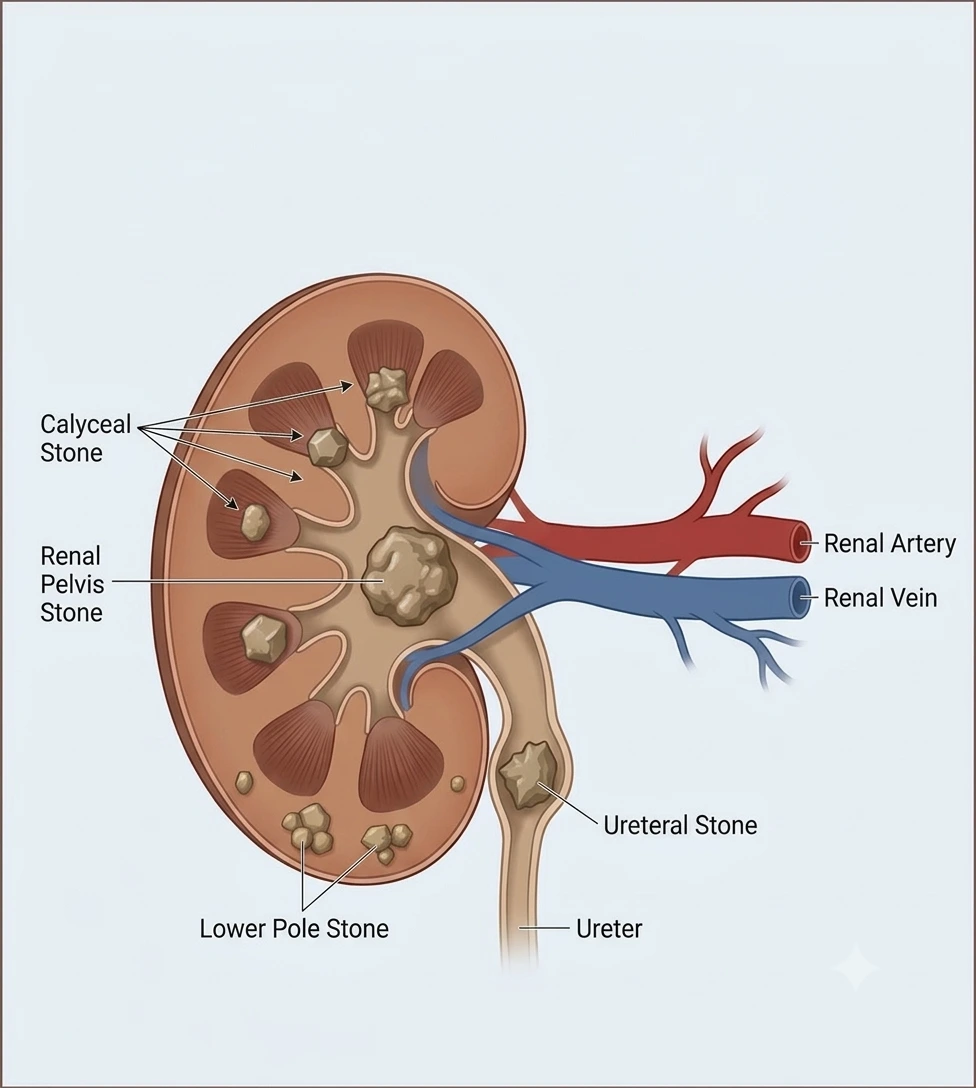
Kidney stones are mineral deposits that crystallise in concentrated urine, most often calcium oxalate. A stone resting in the kidney may cause nothing at all; once it moves into the narrow ureter it blocks urine flow and causes renal colic, one of the most intense pains in medicine.
Almost every stone can now be treated without open surgery; the skill is choosing the right method first time.
Each figure is from a named source.
About one adult in eleven has had a kidney stone at some point in their life.
14.8 per cent of adults in Turkey, part of the global stone belt, have had a stone.
Around 68 per cent of ureteric stones up to 5 mm pass alone, and 47 per cent at 5 to 10 mm.
Without prevention, about half of stone formers form another within ten years.
Pain comes from blockage, not size.
One good scan answers nearly every planning question.
The standard EAU test, showing each stone's size, position and hardness.
Urine culture rules out infection; blood tests check kidney function.
Fragments are analysed; recurrent formers have a 24 hour urine test.
Every modern option, chosen to suit your stone.
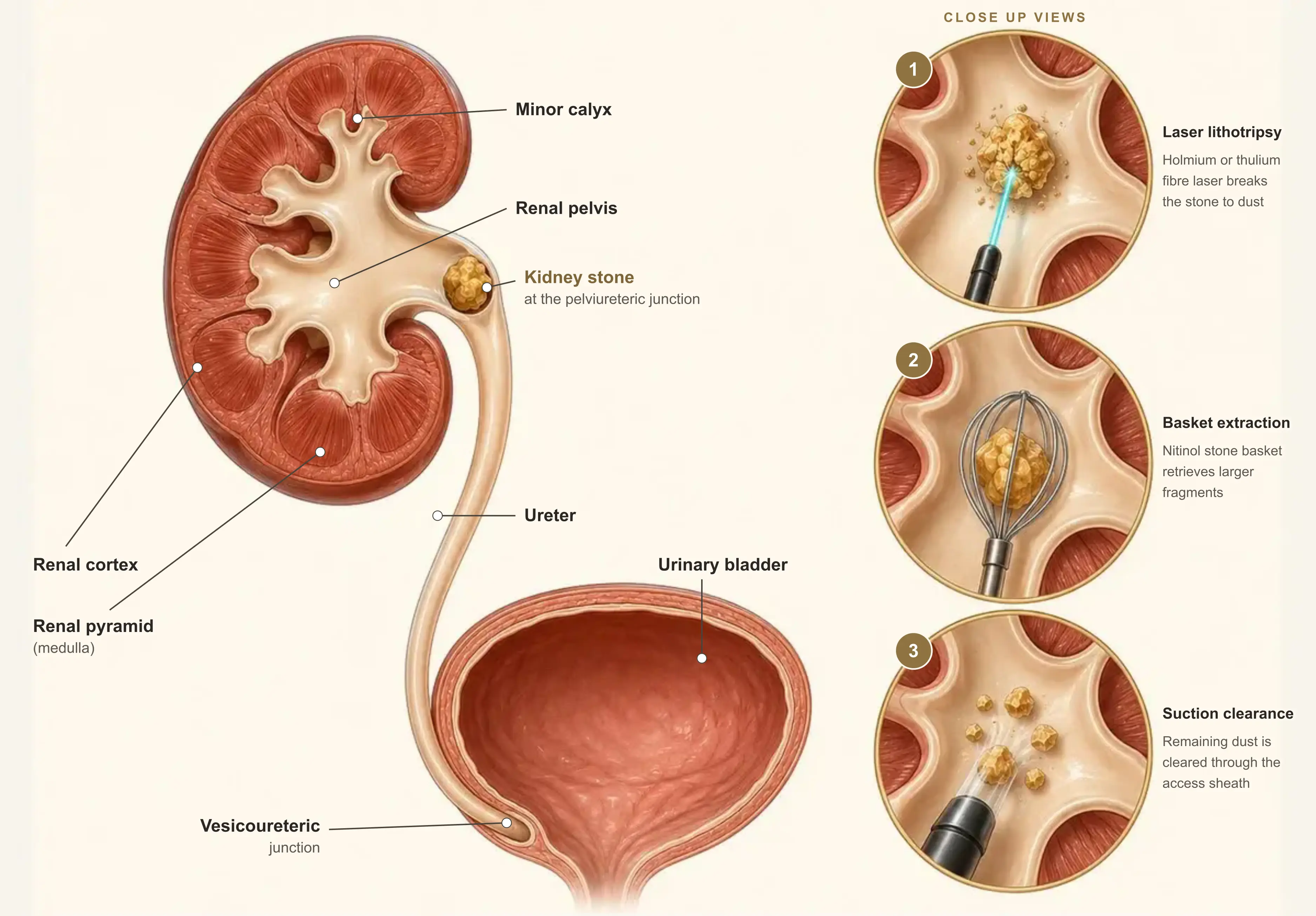
Flexible ureteroscopy: a scope passes up into the kidney and a holmium or thulium laser turns the stone to dust.
A slim scope reaches a stone stuck in the ureter and laser lithotripsy breaks it up, often as a day case.
Through a tunnel under 1 cm wide in the back, the stone is broken and suctioned out.
Shock waves from outside the body crack the stone; more than one session may be needed.
An alpha blocker tablet relaxes the ureter to help a small stone pass on its own, with no procedure.
The usual first choice under EAU guidance; your CT decides.
| Stone | Size | Usual first choiceEAU guideline based | Alternatives |
|---|---|---|---|
| UreterStuck on the way down | Under 10 mm | Medical expulsive therapy, then ureteroscopy if it does not pass | Shock wave lithotripsy |
| UreterStuck on the way down | Over 10 mm | Ureteroscopy with laser | Shock waves, upper ureter |
| KidneyUpper or middle calyx, pelvis | Under 20 mm | Laser RIRS or shock wave lithotripsy | Mini PCNL for hard stones |
| KidneyLower pole | 10 to 20 mm | Laser RIRS or mini PCNL | Shock waves, favourable anatomy |
| KidneyLarge or staghorn | Over 20 mm | Mini PCNL | Laser RIRS in two sessions |
Stones above about 1,000 Hounsfield units resist shock waves. Or try the treatment finder below.
Three quick questions for your likely treatment, stay and price.
Seek medical care today. Fever with stone pain can mean an infected, blocked kidney. It is drained first; the stone is treated once the infection clears.
A guide based on European Association of Urology guidance, not a diagnosis. Your plan is made from your own CT.
Typical, uncomplicated case.
| Treatment | Anaesthesia | Hospital stay | Stent | Back to desk workTypical |
|---|---|---|---|---|
| Laser RIRSFlexible ureteroscopy | General or spinal | Day case or 1 night | Often, 1 to 2 weeks | 2 to 3 days |
| UreteroscopySemi rigid, ureteric stones | General or spinal | Day case or 1 night | Sometimes, up to 1 week | 1 to 3 days |
| Mini PCNLLarge and staghorn stones | General | 1 to 2 nights | Sometimes; often tubeless | 7 to 10 days |
| Shock wave lithotripsyOutside the body | Pain relief or light sedation | None | Rarely | 1 to 2 days |
Avoid heavy lifting for one week after RIRS or ureteroscopy, four after mini PCNL.
Four to five days for RIRS or ureteroscopy; mini PCNL adds one to two.
Send your CT online for a treatment plan and an all inclusive written quote.
Airport transfer to your hotel, then your consultation and tests.
The treatment takes 30 to 90 minutes, usually with one night in hospital.
Rest at your hotel with simple painkillers and plenty of fluid to drink.
Short walks around Istanbul are fine; avoid heavy lifting and keep drinking.
A final check and a discharge letter stating when any stent must come out.
You can fly with a stent once you pass urine normally, have no fever and your pain is controlled.
Knowing why a stone formed stops the next one.
You leave with your stone analysis and a written prevention plan.
Typical self pay prices in US dollars, including the hospital stay.
| Treatment | TurkeyIstanbul, with Dr. Tuncay Taş | United States | United Kingdom | Europe | Gulf countries |
|---|---|---|---|---|---|
| Laser RIRSKidney stones, incl. 1 night and stent | $2,500 to $5,500 | $8,000 to $20,000 | $5,000 to $9,000 | $5,000 to $11,000 | $4,000 to $8,000 |
| Ureteroscopy with laserUreteric stones, incl. stent if needed | $1,800 to $3,500 | $6,000 to $12,500 | $3,500 to $7,000 | $4,000 to $8,000 | $2,500 to $6,000 |
| Mini PCNLLarge or staghorn stones, incl. 1 to 2 nights | $3,000 to $7,000 | $15,000 to $35,000 | $7,500 to $12,000 | $6,000 to $14,000 | $4,000 to $12,000 |
| Shock wave lithotripsyPer session, outpatient | $1,200 to $2,000 | $4,000 to $9,000 | $2,500 to $4,500 | $3,000 to $5,500 | $2,000 to $4,000 |
Approximate ranges from published price guides, October 2026. Your written quote covers tests, surgery, all fees, laser fibre and stent, hospital stay and stone analysis, with accommodation and transfers arranged. Related care: kidney cancer treatment, bladder cancer treatment, prostate cancer treatment, or send your CT for a written opinion.
It depends on stone size and position: laser RIRS or shock waves under 2 centimetres, mini PCNL above that, and ureteroscopy for ureteric stones.
Often, if it is small. Around 68 per cent of ureteric stones up to 5 millimetres pass spontaneously, according to the joint EAU and AUA guideline.
Typically 2,500 to 5,500 US dollars for laser RIRS, including the hospital stay, against 8,000 to 20,000 dollars in the United States.
A blocked, infected kidney is an emergency. EAU guidance is to drain the kidney first and treat the stone once the infection clears.
Without prevention, about half of patients form another within ten years. Stone analysis shows the cause, so prevention can be tailored.
Reviewed by Assoc. Prof. Dr. Tuncay Taş for general information; it does not replace a consultation.