Urologic Oncology · Bladder Cancer

Complete bladder cancer care, from first cystoscopy to long term surveillance

From flexible cystoscopy and transurethral resection to BCG immunotherapy, radical cystectomy with bladder reconstruction and bladder sparing chemoradiotherapy, Assoc. Prof. Tuncay Taş delivers guideline based bladder cancer care in Istanbul, with rapid diagnosis, honest advice and transparent, all inclusive pricing.

Medically reviewed by Assoc. Prof. Dr. Tuncay Taş
75% Diagnosed before muscle invasion
78% Five year survival, all stages
60+ Countries served
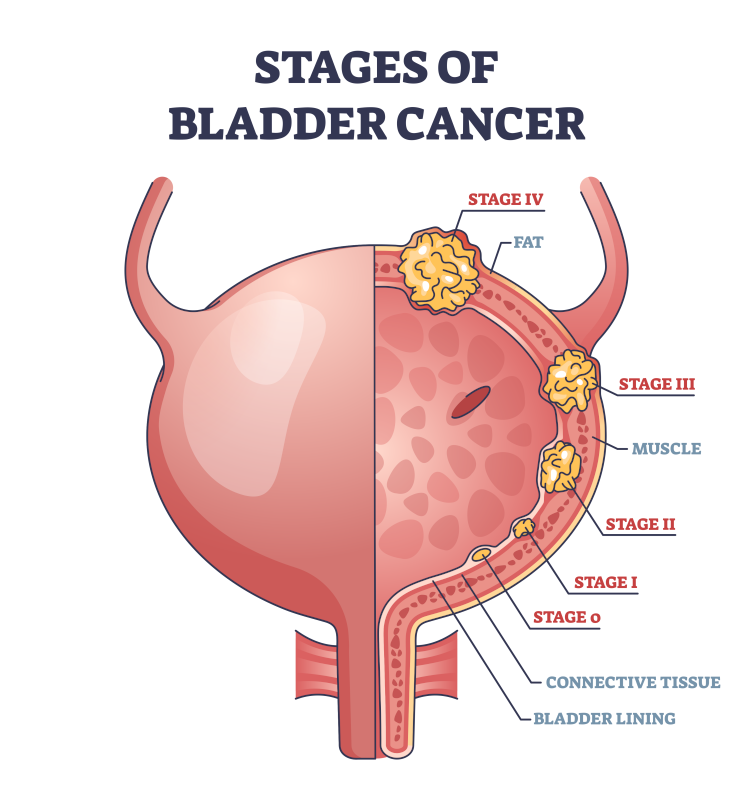
Medical illustration of the stages of bladder cancer in cut away view, from stage 0 in the bladder lining through stage I in the connective tissue, stage II in the bladder muscle, stage III in the surrounding fat and stage IV beyond it
4.9 ★★★★★ Google Reviews
4.9 ★★★★★ Trustpilot
A clear, reassuring starting point

What is bladder cancer?

Bladder cancer is a tumour that starts in the urothelium, the lining that covers the inside of the bladder. It is the ninth most commonly diagnosed cancer in the world, with about 614,000 new cases and 220,000 deaths recorded in 2022, and it is roughly four times more common in men than in women. Around nine in ten cases are urothelial carcinoma, the type that arises from this lining.

What matters most is depth. Around 75 per cent of bladder cancers are found while they are still confined to the lining, before they reach the muscle layer of the bladder wall. These non muscle invasive tumours are removed through the urethra without any incision in the skin, and the bladder is kept. The remaining quarter have grown into the muscle and need more decisive treatment, either removal of the bladder or bladder sparing chemoradiotherapy.

This page sets out, in plain language, how bladder cancer is recognised and staged, which treatments are used at each stage, what they cost in Istanbul, and why the follow up programme matters as much as the first operation.
The short version

Bladder cancer in six facts

If you read nothing else on this page, these are the points that shape every treatment decision.

  • Painless blood in the urine is the main warning sign, present in around 80 per cent of patients at diagnosis, and it typically comes and goes rather than persisting.
  • Depth decides everything. Non muscle invasive tumours, staged Ta, T1 or carcinoma in situ, keep the bladder. Muscle invasive tumours, staged T2 and above, do not.
  • Smoking causes about half of all cases, which makes bladder cancer one of the most preventable urological cancers.
  • Diagnosis needs a camera. No blood test, scan or urine marker can replace cystoscopy and a staging resection of the tumour.
  • Recurrence is the rule, not the exception. Between 15 and 61 per cent of non muscle invasive tumours return within the first year, so surveillance is part of the treatment.
  • Survival is good when it is caught early. Five year relative survival is about 96 per cent for carcinoma in situ and 71 per cent for localised disease.
The evidence behind this page

What the published data actually shows

Every figure quoted on this page is drawn from published guidelines and cancer registry data. The sources are named in full at the foot of the page.

75%
Around 75 per cent of bladder cancers are non muscle invasive when they are first diagnosed, which means the tumour has not grown into the muscle layer of the bladder wall and the bladder can usually be kept.
European Association of Urology, Guidelines on Non muscle invasive Bladder Cancer
~50%
Tobacco smoking is the single largest cause of bladder cancer and accounts for roughly half of all cases in men and women.
European Association of Urology, Guidelines on Non muscle invasive Bladder Cancer
614,000
Bladder cancer accounted for about 614,000 new cases and 220,000 deaths worldwide in 2022, making it the ninth most commonly diagnosed cancer.
GLOBOCAN 2022, International Agency for Research on Cancer
78%
Five year relative survival for bladder cancer across all stages combined is about 78 per cent, rising to roughly 96 per cent for carcinoma in situ and 71 per cent for localised disease.
SEER programme data reported by the American Cancer Society
4 to 1
Bladder cancer is roughly four times more common in men than in women, which is why persistent blood in the urine in a man over 40 is always investigated.
GLOBOCAN 2022, International Agency for Research on Cancer
5 to 8%
Cisplatin based combination chemotherapy given before radical cystectomy improves five year overall survival by an absolute 5 to 8 per cent in muscle invasive disease.
Advanced Bladder Cancer Meta analysis Collaboration, cited in European Association of Urology guidance
Understanding your diagnosis

Types and stages of bladder cancer

Your pathology report gives a stage, which describes how deep the tumour has grown, and a grade, which describes how aggressive the cells look. Together they set the treatment.

Stage What it means Group Usual first treatmentEAU guideline based
TaPapillary, confined to the lining Grows into the bladder cavity, not into the wall Non muscle invasive TURBT, then a single instillation or a course of chemotherapy
Carcinoma in situFlat, high grade Flat, aggressive cells spreading across the lining Non muscle invasive TURBT, then BCG immunotherapy with maintenance
T1Into the connective tissue Through the lining but not yet into muscle Non muscle invasive, high risk Repeat TURBT, then BCG with maintenance
T2Into the bladder muscle Invades the detrusor muscle of the bladder wall Muscle invasive Chemotherapy then radical cystectomy, or chemoradiotherapy
T3 and T4Beyond the bladder Reaches the fat around the bladder or neighbouring organs Locally advanced Combined chemotherapy and surgery, planned case by case
MetastaticSpread to lymph nodes or organs Cancer found outside the pelvis Advanced Platinum chemotherapy and immunotherapy

Grade matters alongside stage. A low grade Ta tumour recurs often but rarely progresses, whereas a high grade T1 tumour behaves aggressively and is treated as a serious threat to the bladder from the outset.

Understanding the causes

What raises the risk of bladder cancer?

Bladder cancer is unusual among cancers in how much of it is explained by exposures you can change. Smoking and workplace chemicals account for the majority of cases.

The largest risks

  • Tobacco smoking. The dominant cause, responsible for about 50 per cent of cases. Carcinogens are filtered by the kidneys and then sit in contact with the bladder lining.
  • Occupational chemicals. Aromatic amines used in dye, rubber, paint, textile, printing and leather work account for a further share of cases, often decades after exposure.
  • Age and sex. Most patients are over 60, and the disease is about four times more common in men than in women.

Other contributing factors

  • Chronic bladder irritation. Long standing infection, long term catheters and bladder stones raise the risk, particularly of squamous cell types.
  • Previous pelvic radiotherapy. Radiotherapy to the pelvis, for example for prostate cancer, slightly increases later bladder cancer risk.
  • Certain chemotherapy drugs. Cyclophosphamide given for other conditions is a recognised risk factor.
  • Family history. A first degree relative with bladder cancer raises your own risk, so tell your urologist.

Stopping smoking still helps after diagnosis

Quitting is worthwhile at every point. Risk in former smokers falls in the years after stopping, although it remains higher than in someone who never smoked. In patients already treated for a non muscle invasive tumour, continued smoking is associated with a higher chance of the cancer returning, which makes stopping part of the treatment rather than general advice.

What to look out for

Symptoms of bladder cancer

Bladder cancer announces itself earlier than most cancers, usually through the urine. The danger is that the warning sign is painless and intermittent, so it is easy to dismiss.

Visible blood in the urine, usually painless, present in around 80 per cent of patients

Blood found only on a urine test, without any visible change

Needing to pass urine urgently or more often than usual

Burning on passing urine that does not settle with antibiotics

A feeling that the bladder has not emptied properly

Pain in the flank, pelvis or bones, or weight loss, in advanced disease

Blood in the urine once is enough reason to be seen

Bleeding from a bladder tumour typically stops on its own after a day or two, which convinces many patients that the problem has resolved. It has not. A single episode of visible blood in the urine in an adult, particularly a man over 40 or anyone who has smoked, warrants a cystoscopy. Urinary infection, stones and an enlarged prostate cause the same symptoms, and only a camera examination can tell them apart.

How bladder cancer is diagnosed

Your diagnostic pathway, step by step

There is no blood test for bladder cancer. Diagnosis is made by looking inside the bladder and by examining the tissue that is removed, supported by imaging of the whole urinary tract.

  1. 01

    Urine tests

    A urine sample is checked for blood, infection and abnormal cells. Urine cytology is particularly useful for detecting high grade disease and carcinoma in situ, although a normal result never rules cancer out on its own.

  2. 02

    Ultrasound of the urinary tract

    A painless scan of the kidneys, ureters and bladder can show larger tumours and rules out stones and obstruction. It is a useful first look, but small or flat tumours are readily missed, so a normal ultrasound never ends the investigation.

  3. 03

    Flexible cystoscopy

    The decisive test. A thin, flexible camera is passed through the urethra under local anaesthetic so the entire bladder lining can be inspected directly. It takes a few minutes, is done while you are awake, and shows the number, size and appearance of any tumour.

  4. 04

    CT urography

    A contrast scan maps the kidneys, ureters and bladder, because urothelial cancer can arise anywhere along that lining. It also assesses the lymph nodes and neighbouring organs, which is essential before deciding on treatment for an invasive tumour.

  5. 05

    TURBT, the staging operation

    Under spinal or general anaesthetic, the tumour is resected through the urethra and the specimen must include bladder muscle so the pathologist can judge depth. Enhanced imaging such as blue light or narrow band cystoscopy improves detection of flat carcinoma in situ.

  6. 06

    Pathology and staging

    The pathologist reports the type, grade and depth of invasion, which places you in a risk group and sets the treatment. In high grade T1 disease a second resection within six weeks is standard, because it changes the stage in a significant proportion of patients.

The quality of the first resection shapes everything that follows

A TURBT is both an operation and the staging test on which all later decisions rest. If muscle is absent from the specimen, the depth of the tumour cannot be judged and the true stage may be understated. This is why the experience of the surgeon performing that first resection matters far more than it appears at the time.

A full range of treatments

Bladder cancer treatment options

The right treatment follows from the stage, the grade and your general health. Most patients need a combination, planned together from the start rather than one step at a time.

All stages

TURBT

Transurethral resection removes the tumour through the urethra with no incision in the skin. It both treats non muscle invasive disease and provides the tissue that determines the stage, which is why the completeness of the resection is so important.

Low risk

Single instillation chemotherapy

A single dose of chemotherapy placed into the bladder within hours of TURBT significantly lowers the chance of a low risk tumour returning. It is given through the catheter already in place and adds nothing to your recovery time.

Intermediate and high risk

BCG immunotherapy

BCG is instilled into the bladder to provoke a local immune response against residual cancer cells. Guidelines recommend an induction course followed by one to three years of maintenance in high risk disease, and it is the most effective way to keep the bladder.

Muscle invasive

Radical cystectomy

Removal of the bladder with pelvic lymph node dissection, followed by a urinary diversion. It offers the strongest cancer control for muscle invasive disease and can be performed openly, laparoscopically or robotically.

Bladder sparing

Trimodal therapy

A complete resection followed by radiotherapy with concurrent chemotherapy allows selected patients with a single, fully resected tumour to keep the bladder, with careful cystoscopic surveillance afterwards.

Systemic

Chemotherapy and immunotherapy

Cisplatin based chemotherapy before cystectomy improves survival in muscle invasive disease. In advanced and metastatic cancer, platinum chemotherapy and immune checkpoint inhibitors control the disease and protect quality of life.

A closer look

Keeping the bladder: TURBT and BCG in focus

For the roughly three quarters of patients whose tumour has not reached the muscle, treatment aims to clear the cancer and keep the bladder working for the rest of their life.

What TURBT involves

  • Carried out under spinal or general anaesthetic, with no cut in the skin
  • The tumour and a sample of underlying muscle are resected and sent for pathology
  • A catheter drains the bladder for one to two days while the area heals
  • Most patients stay one to two nights and return to normal activity within two weeks
  • A repeat resection at six weeks is standard for high grade T1 tumours

What BCG involves

  • Given as a liquid through a catheter, held in the bladder for two hours
  • An induction course of six weekly instillations, then maintenance for one to three years
  • Urinary frequency, burning and a mild flu like reaction are common for a day or two
  • Serious reactions are uncommon and are treated promptly when they occur
  • Cystoscopy at three months tells your team how well the treatment has worked
Risk group Typical tumour Treatment after TURBT Cystoscopy scheduleFirst two years
Low risk Single, small, low grade Ta One immediate instillation of chemotherapy At 3 months, then annually
Intermediate risk Multiple or recurrent low grade Ta Chemotherapy course or one year of BCG Every 3 to 6 months
High risk High grade, T1 or carcinoma in situ BCG with one to three years of maintenance Every 3 months
Highest risk BCG unresponsive or extensive high grade T1 Radical cystectomy is discussed early Individual, alongside surgical planning

Schedules follow European Association of Urology risk tables and are adapted to your own pathology. Between 15 and 61 per cent of non muscle invasive tumours recur within the first year, which is why surveillance cystoscopy is treated as part of the treatment rather than an optional review.

When the muscle is involved

Radical cystectomy, urinary diversion and bladder sparing therapy

Muscle invasive bladder cancer is treated decisively. The choice between removing the bladder and preserving it depends on the tumour, your kidney function and your own priorities.

01

Chemotherapy first

Cisplatin based combination chemotherapy given before surgery improves five year overall survival by an absolute 5 to 8 per cent compared with surgery alone, so it is offered to every patient whose kidney function and general health allow it. It usually runs for three to four cycles before the operation.

02

Radical cystectomy and diversion

The bladder and pelvic lymph nodes are removed, together with the prostate in men or the uterus and part of the vagina in women. Urine is then rerouted, either to an ileal conduit with an external bag, or into a neobladder built from bowel so that you pass urine through the urethra as before.

03

Bladder sparing chemoradiotherapy

For selected patients with a single tumour that has been completely resected and no carcinoma in situ, radiotherapy given alongside chemotherapy can control the cancer while keeping the bladder. It demands rigorous cystoscopic follow up, and cystectomy remains available if the cancer returns.

A neobladder is not right for everyone

Building a new bladder from bowel allows most patients to pass urine in the usual way, but it requires good kidney and liver function, a urethra free of cancer, the manual dexterity to catheterise if needed, and a real commitment to the retraining period. An ileal conduit is simpler, more reliable and entirely compatible with an active life. The honest comparison of both is part of your consultation, not an afterthought.

Bladder cancer is not one operation, it is a programme. The first resection has to be complete and it has to contain muscle, otherwise every decision that follows rests on an uncertain stage. What I tell every patient who flies to Istanbul is that they leave with two things: the tumour removed, and a written surveillance schedule for the next five years.
Assoc. Prof. Dr. Tuncay Taş, Consultant Urologist and Andrologist, Istanbul
Transparent pricing

Bladder cancer treatment cost in Turkey

These are guide prices with Assoc. Prof. Tuncay Taş in Istanbul, set against typical costs in the United States, the United Kingdom and Europe. The same standard of care, at a fraction of the price. Your final quote is confirmed in writing after your consultation, with no hidden costs.

Treatment Dr. Tuncay Taş Istanbul, Turkey United States United Kingdom Europe
Flexible cystoscopyDiagnosis or surveillance $300 to $600 $1,500 to $3,500 £800 to £1,500 €900 to €1,800
TURBTResection, incl. hospital stay $2,500 to $4,000 $12,000 to $25,000 £6,000 to £11,000 €7,000 to €13,000
BCG courseSix week induction $1,500 to $2,800 $8,000 to $18,000 £4,000 to £8,000 €5,000 to €9,000
Radical cystectomy with diversionSurgery, incl. hospital stay $9,000 to $13,000 $40,000 to $80,000 £25,000 to £40,000 €28,000 to €45,000

Your quote covers the procedure, the surgeon fee, hospital and clinic care and your aftercare. For international patients, accommodation and airport transfers are arranged too. Prices are a guide and are confirmed in writing after your consultation.

North America

Why United States and Canada patients choose Turkey

Bladder cancer is a disease of surveillance rather than a single operation. After the first tumour is removed you need repeated cystoscopies, instillations and scans for years, and in North America every one of those visits carries its own bill. In the United States, deductibles and out of pocket costs mount with each cycle of BCG, while Canadian patients routinely wait months for a cystoscopy slot that Istanbul offers within days. Here you are assessed quickly, treated to European Association of Urology standards in accredited hospitals, given one written all inclusive price, and followed up by video once you are home.

After treatment

Your recovery and surveillance, step by step

Recovery after TURBT is quick. What lasts is the follow up, and knowing the schedule in advance is what makes it manageable from another country.

Days 1 to 2

One or two nights in hospital after TURBT with a catheter draining the bladder. Mild burning and pink urine are expected while the resected area heals.

Week 1 to 2

The catheter is removed before you fly home. Light activity resumes straight away, while heavy lifting, cycling and strenuous exercise are avoided for about two weeks.

Week 2 to 6

Pathology results are reviewed with you and your risk group is confirmed. BCG or chemotherapy instillations begin, and a repeat resection is arranged if your tumour was high grade T1.

Ongoing surveillance

Cystoscopy at three months sets the pattern, then every three to six months or annually according to your risk group. Your written schedule travels home with you and video review keeps your team involved.

For patients travelling to us

International patient services

Everything beyond the clinical care is handled for you, so your visit to Istanbul feels calm, private and well organised.

Free online consultation and review of your scans and pathology before you travel

Help with flights and comfortable accommodation

Private airport and hospital transfers

Language support throughout your stay

A written surveillance schedule to give to your doctor at home

Video follow up and review of your cystoscopy results once you are home

Good to know

Frequently asked questions

Is bladder cancer curable?

In most patients, yes. Around 75 per cent of bladder cancers are non muscle invasive at diagnosis, and these are treated by removing the tumour through the urethra and then protecting the bladder with instillations, with no external incision at all. Five year relative survival across all stages is about 78 per cent, and roughly 96 per cent for carcinoma in situ. Even muscle invasive disease is curable when it is treated promptly with radical surgery or with chemoradiotherapy, so the decisive factor is how quickly the diagnosis is made.

What is the first sign of bladder cancer?

Painless blood in the urine is the classic first sign and is present in around 80 per cent of patients at presentation. The bleeding is often visible, it is usually not painful, and it very typically comes and goes, so many men wrongly assume the problem has resolved. Blood in the urine on a single occasion is enough reason to see a urologist. Some patients instead notice urinary urgency, frequency or burning that does not settle with antibiotics.

What is BCG treatment and how well does it work?

BCG is an immunotherapy given as a liquid instilled directly into the bladder through a catheter, where it provokes a local immune response against remaining cancer cells. For intermediate and high risk non muscle invasive disease it is the most effective bladder sparing treatment available, and European Association of Urology guidance recommends a full induction course followed by one to three years of maintenance in high risk patients. Side effects are usually limited to urinary frequency, burning and a mild flu like reaction for a day or two.

Will I lose my bladder?

Most patients do not. The bladder is preserved in the great majority of non muscle invasive cases, which is roughly three quarters of all diagnoses. Radical cystectomy, meaning removal of the bladder, is reserved for muscle invasive disease and for high risk tumours that keep returning despite BCG. Where the bladder does have to be removed, a new bladder can often be built from a segment of bowel so that you pass urine in the usual way, and your surgeon discusses every option with you before anything is decided.

How much does bladder cancer treatment cost in Turkey?

Bladder cancer treatment in Turkey costs a fraction of the price in the United States, Canada, the United Kingdom or Western Europe for the same standard of care. As a guide, TURBT starts from around 2,500 to 4,000 US dollars and radical cystectomy with urinary diversion from around 9,000 to 13,000 US dollars, including the hospital stay. Your exact, all inclusive quote is confirmed in writing after your consultation, with no hidden costs and no surprise billing.

How long will I need to stay in Istanbul?

For a cystoscopy and TURBT, most international patients plan a stay of about five to seven days, which covers assessment, the procedure, catheter removal and a final check before flying home. For radical cystectomy the stay is longer, usually around three weeks, because recovery from major surgery and the training you need for your urinary diversion both take time. Your coordinator builds the schedule around your flights.

References

Sources used on this page

Figures and treatment recommendations on this page are drawn from the following published guidelines and datasets.

  1. European Association of Urology. Guidelines on Non muscle invasive Bladder Cancer (TaT1 and Carcinoma in situ).
  2. European Association of Urology. Guidelines on Muscle invasive and Metastatic Bladder Cancer.
  3. International Agency for Research on Cancer. GLOBOCAN 2022 global cancer statistics.
  4. American Cancer Society. Bladder cancer survival rates, based on the SEER programme of the National Cancer Institute.
  5. Advanced Bladder Cancer Meta analysis Collaboration. Neoadjuvant chemotherapy in invasive bladder cancer.
  6. World Health Organization. Classification of Tumours of the Urinary System and Male Genital Organs.

This page is written for general information and reviewed by Assoc. Prof. Dr. Tuncay Taş. It does not replace an individual consultation, and treatment recommendations always depend on your own pathology, imaging and general health.

WhatsApp