Partial nephrectomy
The tumour is removed with a rim of healthy tissue and the rest of the kidney stays in place. Standard for T1 tumours up to 7 centimetres: equivalent cancer control, protected kidney function.
Leave your details and we'll be in touch within one working day.
Robotic and laparoscopic partial nephrectomy, radical nephrectomy, ablation, active surveillance and modern immunotherapy, delivered to European Association of Urology standards by Assoc. Prof. Tuncay Taş in Istanbul, with transparent, all inclusive pricing.
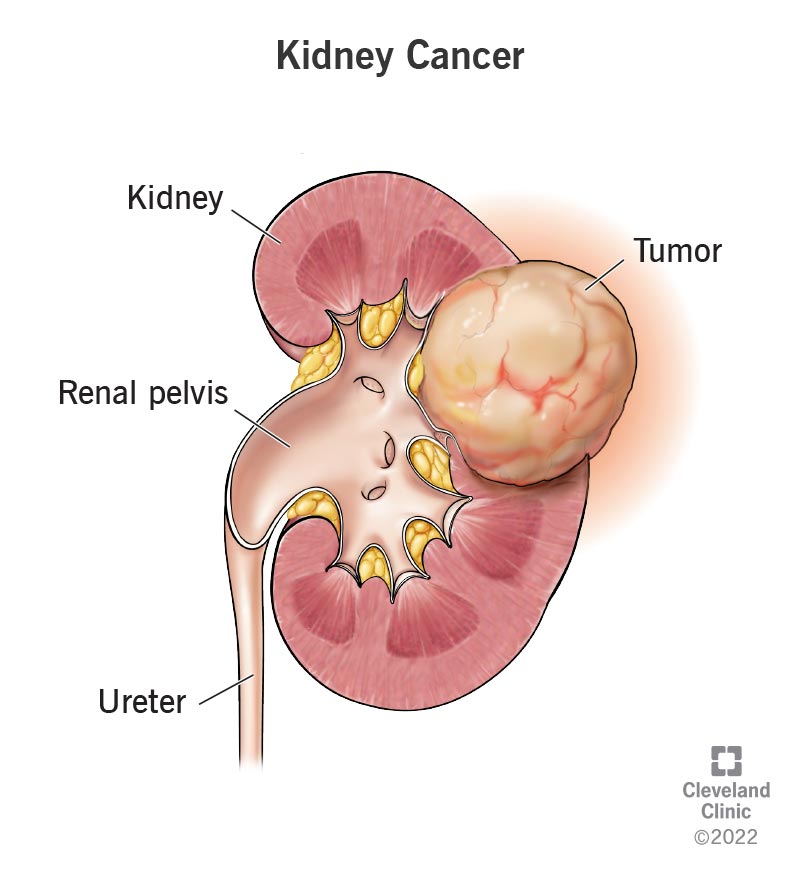
Kidney cancer is a tumour that starts in the tissue of the kidney, most often in the small tubes that filter the blood. It caused 434,840 new cases worldwide in 2022, is about twice as common in men, and around nine in ten cases are renal cell carcinoma.
What makes it different is how it is found: roughly 60 per cent of tumours are picked up by chance on a scan ordered for an unrelated reason, which is why survival is comparatively good at 93 per cent while the tumour is confined to the kidney. It behaves differently in treatment too. Renal cell carcinoma resists conventional chemotherapy and radiotherapy, so surgery does the curative work and immunotherapy handles advanced disease.
Every figure comes from published guidelines, registry data or peer reviewed trials, named in full below.
Five year relative survival is 93 per cent while kidney cancer is confined to the kidney, 76 per cent once it reaches nearby tissue and 19 per cent once it has spread.
About 60 per cent of kidney cancers are found by chance on a scan ordered for something else, rising to 87 per cent of the smallest T1a tumours.
Kidney cancer caused 434,840 new cases and roughly 155,700 deaths worldwide in 2022, the fourteenth most commonly diagnosed cancer.
Around 70 per cent of renal cell carcinomas are clear cell, with papillary tumours accounting for 13 to 20 per cent.
Approximately 15 per cent of renal masses removed at surgery turn out to be benign.
In KEYNOTE-564, immunotherapy after surgery raised four year overall survival to 91.2 per cent against 86.0 per cent on placebo, a hazard ratio for death of 0.62.
Staging follows tumour size and how far it has grown beyond the kidney, with Gerota's fascia separating locally advanced from advanced disease.
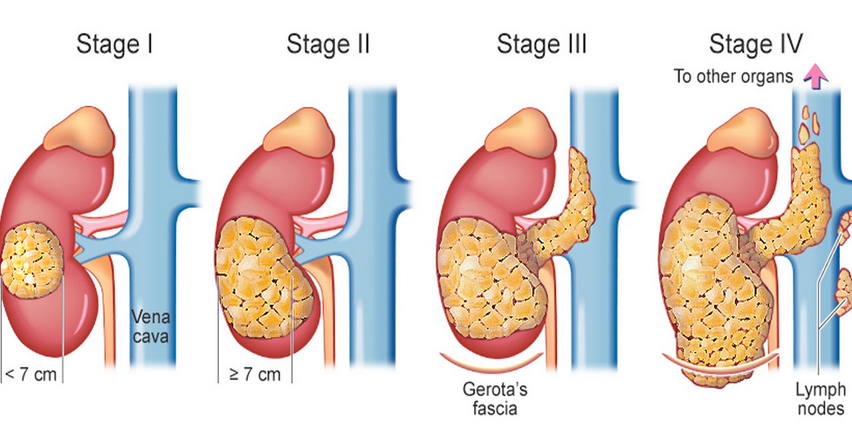
| Stage | What it means | Five year survival | Usual first treatmentEAU guideline based |
|---|---|---|---|
| Stage IT1, under 7 cm | Under 7 centimetres, inside the kidney | 93% while confined | Partial nephrectomy, keeping the kidney; ablation or surveillance in selected patients |
| Stage IIT2, 7 cm or more | 7 centimetres or larger, still confined | 93% while confined | Radical nephrectomy, laparoscopic or robotic where possible |
| Stage IIIT3 or node positive | Reaches the renal vein, vena cava, the fat inside Gerota's fascia, or nodes | 76% regional | Radical nephrectomy with node dissection, then adjuvant immunotherapy |
| Stage IVT4 or metastatic | Beyond Gerota's fascia, into the adrenal gland, or spread to distant organs | 19% distant | Systemic immunotherapy with targeted therapy, surgery in selected patients |
Grade sits alongside stage, running from 1 to 4, so a small but high grade tumour is watched more closely than its size suggests. Survival figures are SEER relative survival for patients diagnosed 2015 to 2021.
Quoted exactly as they appear in the source, each with what it means in practice.
The classic triad of flank pain, visible haematuria, and a palpable abdominal mass is rare today and generally correlates with aggressive disease.
Waiting for symptoms means waiting for the disease to advance, which is why an incidental finding is good news.
Adjuvant pembrolizumab was associated with a significant and clinically meaningful improvement in overall survival, as compared with placebo, among participants with clear-cell renal-cell carcinoma at increased risk for recurrence after surgery.
For higher risk tumours, surgery is no longer the end of treatment, so the plan is made before the operation.
People now being diagnosed with kidney cancer may have a better outlook than these numbers show.
These rates describe patients treated up to a decade ago. Robotic kidney sparing surgery and modern immunotherapy arrived after they were counted.
Kidney cancer is quiet: about 60 per cent of tumours are found before any symptom appears, and symptoms usually signal advanced disease.
European Association of Urology guidance names increased physical activity, stopping smoking and weight reduction as the primary preventative measures, and these act independently.
Kidney cancer is diagnosed by imaging rather than biopsy in most patients: a contrast enhanced scan showing a solid, enhancing mass is enough to plan surgery.
Separates a simple cyst, which needs nothing, from a solid mass, which needs a CT.
The decisive test: whether the mass takes up contrast is what identifies a renal cell carcinoma. It also measures the tumour and checks the renal vein, vena cava and nodes. A chest CT completes staging.
Creatinine, eGFR and urinalysis decide how hard to push to preserve tissue. Biopsy is not routine, but is used before ablation or systemic therapy, since approximately 15 per cent of removed masses prove benign.
Size, depth and proximity to the collecting system and blood vessels decide whether a partial nephrectomy is possible, and the CT answers that before you come to theatre. Sending your imaging in advance often shortens the trip.
Treatment follows from the stage, the tumour and how well your kidneys work. Most stage I and II patients need surgery alone.
The tumour is removed with a rim of healthy tissue and the rest of the kidney stays in place. Standard for T1 tumours up to 7 centimetres: equivalent cancer control, protected kidney function.
The whole kidney is removed with surrounding fat and, where indicated, lymph nodes. The right operation for larger or central tumours and those involving the renal vein.
A needle through the skin freezes or heats tumours under 3 centimetres in patients unfit for surgery. Masses under 4 centimetres grow slowly, so they can instead be followed.
A year of pembrolizumab after complete removal of a higher risk clear cell tumour. In KEYNOTE-564 this raised four year overall survival to 91.2 per cent against 86.0 per cent on placebo, a hazard ratio for death of 0.62.
Immune checkpoint inhibitors, paired or with a targeted tyrosine kinase inhibitor, are first line for metastatic disease. Removing the primary tumour or a few deposits helps selected patients.
Both operations control the cancer; they differ in how much working kidney you keep.
| Approach | Incisions | Hospital stay | Back to normal activityTypical, uncomplicated case |
|---|---|---|---|
| Robotic or laparoscopic partial nephrectomyKidney preserved | Three to five keyhole ports | 2 to 4 nights | 2 to 3 weeks |
| Laparoscopic or robotic radical nephrectomyKidney removed | Keyhole ports plus a small extraction incision | 2 to 4 nights | 3 to 4 weeks |
| Open radical nephrectomyLarge or vein involving tumours | One flank or abdominal incision | 5 to 7 nights | 5 to 8 weeks |
| Percutaneous ablationSmall tumours, unfit for surgery | A needle through the skin | Day case or 1 night | 3 to 7 days |
The kidney is preserved where the tumour is stage T1 and reachable safely, which matters most if kidney function is already reduced or you have only one working kidney. It is removed where the tumour is large or central, extends into the renal vein, or where preserving tissue would compromise the cancer clearance.
Most of my kidney cancer patients arrive frightened by a scan they never expected to have, and the first thing I tell them is that being found by accident is the best way to be found. The second is that in a tumour under seven centimetres my aim is to remove the cancer and give you the kidney back.
Guide prices with Assoc. Prof. Tuncay Taş in Istanbul against typical costs elsewhere.
| Treatment | Dr. Tuncay Taş Istanbul, Turkey | United States | United Kingdom | Europe |
|---|---|---|---|---|
| Diagnostic work upCT, bloods, consultation | $600 to $1,200 | $3,000 to $7,000 | £1,500 to £3,000 | €1,800 to €3,500 |
| Partial nephrectomyRobotic or laparoscopic, incl. hospital stay | $7,000 to $11,000 | $30,000 to $60,000 | £16,000 to £28,000 | €18,000 to €32,000 |
| Radical nephrectomyLaparoscopic, incl. hospital stay | $6,500 to $9,500 | $25,000 to $55,000 | £14,000 to £24,000 | €15,000 to €28,000 |
| Cryoablation or radiofrequency ablationSmall renal mass | $4,500 to $7,000 | $18,000 to $35,000 | £9,000 to £16,000 | €10,000 to €18,000 |
Your quote covers the procedure, surgeon fee, hospital care, pathology and aftercare, with accommodation and transfers arranged for international patients. Immunotherapy is priced per cycle and quoted separately. Related care: bladder cancer treatment, prostate cancer treatment, kidney stone treatment, or send your scans for a written opinion.
In most patients, yes. Five year relative survival is 93 per cent while the tumour is confined to the kidney, which is how most are found, and surgery alone cures the majority. It falls to 76 per cent regionally and 19 per cent once spread.
Yes, and it is usually the preferred operation. Partial nephrectomy removes the tumour with a rim of healthy tissue while the rest of the kidney stays in place. It is standard for stage T1 tumours up to 7 centimetres, with the same cancer control.
Most often there is none. European Association of Urology guidance states that the classic triad of flank pain, visible haematuria and a palpable abdominal mass is rare today and generally correlates with aggressive disease. Around 60 per cent of cases are found incidentally on a scan.
Renal cell carcinoma is largely resistant to conventional chemotherapy, so it is not a standard treatment. Advanced disease is treated with immune checkpoint inhibitors and targeted tyrosine kinase inhibitors. In KEYNOTE-564, a year of immunotherapy after surgery raised four year overall survival to 91.2 per cent against 86.0 per cent.
A fraction of the price elsewhere for the same standard of care. Partial nephrectomy starts from around 7,000 to 11,000 US dollars and radical nephrectomy from 6,500 to 9,500, both including the hospital stay, against 30,000 to 60,000 dollars in the United States.
About ten to fourteen days, covering your scans, the operation, two to four nights in hospital, the pathology result and a final consultation.
Yes. A single healthy kidney takes over most of the filtering work within a few months, the same principle that makes living donation safe. You will not need dialysis, but you do need an annual check of blood pressure and kidney function.
Your schedule is set by stage and pathology, and you leave Istanbul with it in writing. For low risk stage I disease, imaging and kidney function tests every six to twelve months for three years, then annually; for higher risk disease, every three to six months.
Written for general information and reviewed by Assoc. Prof. Dr. Tuncay Taş. It does not replace an individual consultation, and treatment always depends on your own imaging and pathology.